Sales Funnel Stages in Practice: How Businesses Turn Leads into Customers
What happens after a lead enters your sales funnel? Learn the practical stages of a modern sales process—from advertising and lead capture to qualification, CRM management, sales, and repeat customers.
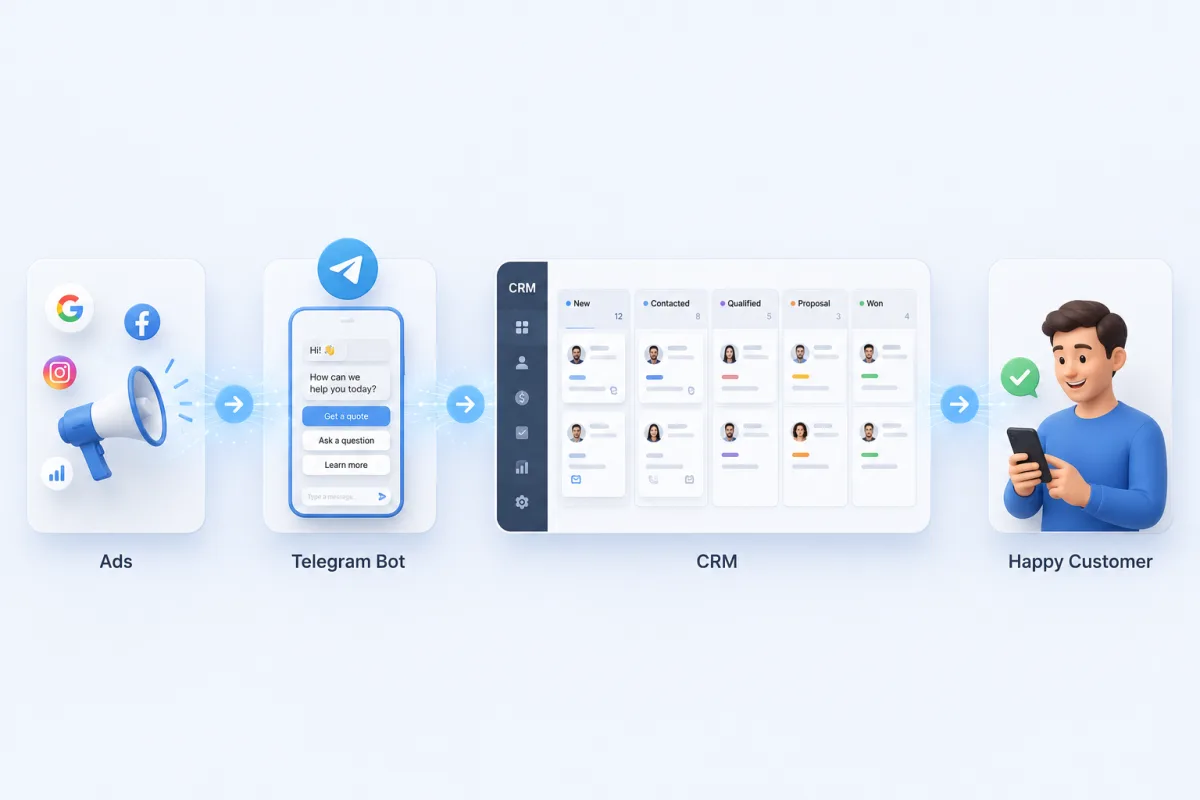
Understanding the theory behind a sales funnel is useful. But the real value comes from applying it in a business environment.
Many companies focus heavily on generating traffic and leads. However, successful businesses pay equal attention to what happens after a lead enters the funnel.
A sales funnel is not just a marketing concept. It is a sequence of actions that guides potential customers from first contact to purchase and beyond.
In this article, we'll walk through the practical stages of a sales funnel and show how businesses use automation, CRM systems, and Telegram bots to improve results.
What a Sales Funnel Looks Like in Real Life
A typical sales funnel follows this path:
Advertising → First Contact → Lead Capture → Conversation → Qualification → Offer → Sale → Repeat Sales
Each stage has a specific purpose.
If one stage performs poorly, the entire funnel becomes less effective.
Let's examine each step.
Stage 1: Advertising
Every funnel begins with traffic.
Potential customers discover a business through:
- Google search;
- social media;
- paid advertising;
- referrals;
- blog content;
- YouTube videos.
At this stage, people are usually unaware of your company.
The goal is not to sell immediately.
The goal is to attract the right audience and generate interest.
Common mistake:
Many businesses focus entirely on traffic volume while ignoring what happens after visitors arrive.
Stage 2: First Contact
Once a prospect discovers your business, the first interaction begins.
This could happen through:
- a website;
- a landing page;
- a Telegram bot;
- a contact form;
- a social media message.
The first few seconds matter.
Visitors quickly decide:
- whether they understand your offer;
- whether they trust your business;
- whether they should continue.
Common mistake:
Confusing messaging and unclear value propositions often cause prospects to leave before becoming leads.
Stage 3: Lead Capture
At this stage, anonymous visitors become identifiable leads.
Typical actions include:
- submitting a form;
- requesting a quote;
- scheduling a consultation;
- sending a message;
- subscribing to a newsletter.
Now the business has a way to continue communication.
Without lead capture, traffic has little long-term value.
Common mistake:
Asking for too much information too early.
The more fields users must complete, the lower the conversion rate.
Stage 4: Conversation
After capturing the lead, communication begins.
This can happen through:
- email;
- phone calls;
- Telegram;
- WhatsApp;
- website chat.
The objective is simple:
Understand the prospect's situation and build trust.
Many businesses lose opportunities here because responses are delayed.
A lead who waits several hours may already be speaking with competitors.
Stage 5: Qualification
Not every lead is ready to buy.
Qualification helps determine:
- whether the lead fits your target audience;
- whether there is a real need;
- whether the prospect has decision-making authority;
- whether the budget is realistic.
Good qualification prevents sales teams from wasting time on poor-fit opportunities.
Common mistake:
Treating every lead as equally valuable.
Stage 6: Presenting the Offer
Once the prospect is qualified, the business presents a solution.
The offer may include:
- pricing;
- implementation details;
- timelines;
- service packages;
- product recommendations.
A strong offer focuses on outcomes rather than features.
Instead of describing what the product does, it explains what problem it solves.
Common mistake:
Sending generic proposals that fail to address the prospect's specific needs.
Stage 7: Closing the Sale
This is the stage where the prospect becomes a customer.
By this point, the lead should:
- understand the offer;
- trust the company;
- see clear value.
Businesses often lose deals here because:
- follow-ups stop;
- objections are not handled;
- communication becomes slow;
- the buying process is complicated.
Closing a sale is often the result of successfully managing all previous stages.
Stage 8: Repeat Sales
Many companies treat the sale as the finish line.
In reality, it is often the beginning of the most profitable stage.
Existing customers are typically easier to sell to than new prospects.
Repeat sales may include:
- renewals;
- upgrades;
- additional services;
- cross-selling;
- long-term contracts.
Businesses that focus only on acquiring new leads often overlook significant revenue opportunities from existing customers.
Practical Example: A Small Business
Imagine a local home renovation company.
Their sales funnel might look like this:
- A homeowner searches Google for renovation services.
- They click an advertisement.
- They visit the website.
- They submit a quote request.
- The company contacts them.
- Requirements are discussed.
- A proposal is sent.
- The customer signs a contract.
- Future renovation projects create repeat business.
At every stage, customers can leave the process.
That is why tracking funnel performance is critical.
How a Telegram Bot Fits into the Funnel
A Telegram bot can improve multiple stages of the funnel.
For example, the bot can:
- answer common questions instantly;
- collect contact information;
- qualify leads automatically;
- schedule consultations;
- send reminders;
- route leads to managers.
Instead of waiting for a human response, prospects receive immediate engagement.
This often increases conversion rates and reduces lead loss.
How CRM Systems Support the Funnel
A CRM system helps businesses track every lead.
It records:
- customer information;
- communication history;
- funnel stage;
- tasks and follow-ups;
- sales outcomes.
Without a CRM, businesses often experience:
- lost leads;
- missed follow-ups;
- inconsistent communication.
A CRM creates visibility across the entire funnel.
Managers can immediately identify where prospects are getting stuck.
Why Businesses Lose Customers Between Stages
One of the biggest lessons from real-world funnels is this:
Customers rarely disappear without a reason.
Common causes include:
- slow response times;
- unclear offers;
- poor qualification;
- no follow-up process;
- lack of automation;
- no funnel tracking.
Every stage introduces potential losses.
The goal is not to eliminate all losses but to reduce them wherever possible.
Building a Modern Sales Funnel
Today, businesses increasingly combine:
- advertising platforms;
- landing pages;
- Telegram bots;
- CRM systems;
- automation tools;
- analytics dashboards;
- AI assistants.
Together, these tools create a structured system that guides prospects from awareness to purchase.
The result is more predictable growth and better use of marketing budgets.
Final Thoughts
A sales funnel is more than a diagram. It is a real business process that determines how effectively a company turns prospects into customers.
Understanding each stage helps businesses:
- improve conversion rates;
- reduce lead loss;
- increase sales efficiency;
- create better customer experiences.
The companies that consistently grow are not necessarily the ones with the most traffic. They are the ones that understand every stage of their sales funnel and continuously improve it.
When advertising, communication, automation, CRM systems, and follow-ups work together, the entire funnel becomes stronger — and more profitable.