How Automation Helps Guide Customers to a Purchase
Learn how automation helps guide customers from first contact to purchase using Telegram bots, AI qualification, structured workflows, analytics, and follow-up sequences.
Every customer follows a journey before making a purchase.
They see an advertisement, visit a website, ask questions, submit an inquiry, talk to a sales representative, evaluate the offer, and finally decide whether to buy.
At every stage, a business can lose a potential customer.
The reason is often not the price or the product itself. More commonly, sales are lost because of slow responses, missed inquiries, disconnected communication, or too many manual tasks.
Automation helps remove these obstacles and creates a smoother, more consistent customer journey.
The First Interaction Starts Before a Sales Manager Joins
Modern customers expect immediate responses.
If someone clicks on an advertisement and arrives at your website but receives no assistance, there is a good chance they will leave before making contact.
Automation allows your business to engage visitors from the very first moment.
For example, a Telegram bot can:
- answer the first message;
- introduce your services;
- recommend the most relevant option;
- collect contact information.
While your team is busy with other conversations, every new visitor still receives immediate attention.
AI Helps Understand Customer Needs
The beginning of a sales conversation usually includes the same questions.
What service are you looking for?
What is your budget?
When would you like to get started?
AI can handle this initial qualification automatically.
By the time a sales manager joins the conversation, the customer's basic requirements are already known.
This saves time and allows the discussion to focus on finding the right solution.
Every Lead Becomes Part of One Process
Today's businesses receive inquiries from many different sources:
- websites;
- Telegram;
- social media;
- online advertising;
- contact forms.
Automation brings all of these inquiries into a single workflow.
Regardless of where a lead comes from, the customer follows the same structured process.
This reduces confusion and makes it much less likely that valuable opportunities will be overlooked.
Sales Managers Join at the Right Time
Automation does not replace people.
It removes repetitive work so people can focus on selling.
When a sales manager starts communicating with a prospect, they already have access to:
- the source of the inquiry;
- conversation history;
- customer responses;
- qualification results.
Instead of collecting basic information, the manager can immediately concentrate on solving the customer's problem.
Routine Tasks Run Automatically
Many businesses spend hours every day on repetitive administrative work.
For example:
- sending welcome messages;
- creating tasks;
- reminding customers about appointments;
- sending follow-up materials;
- recording conversation results.
These activities can be automated.
As a result, employees spend less time on routine work and more time building relationships with customers.
Analytics Shows the Complete Picture
Automation makes the entire customer journey visible.
You can see:
- how many visitors came from advertising;
- how many started a conversation;
- how many submitted an inquiry;
- how many received an offer;
- how many became customers.
This data helps identify which stages perform well and which need improvement.
Instead of relying on assumptions, businesses can make decisions based on measurable results.
Automation Continues After the Sale
The customer journey does not end with a successful purchase.
For many businesses, repeat customers generate a significant share of revenue.
Automation can continue supporting the relationship by:
- sending thank-you messages;
- delivering onboarding information;
- reminding customers about repeat orders;
- introducing new services;
- recommending related products.
Keeping existing customers engaged is often more cost-effective than constantly acquiring new ones.
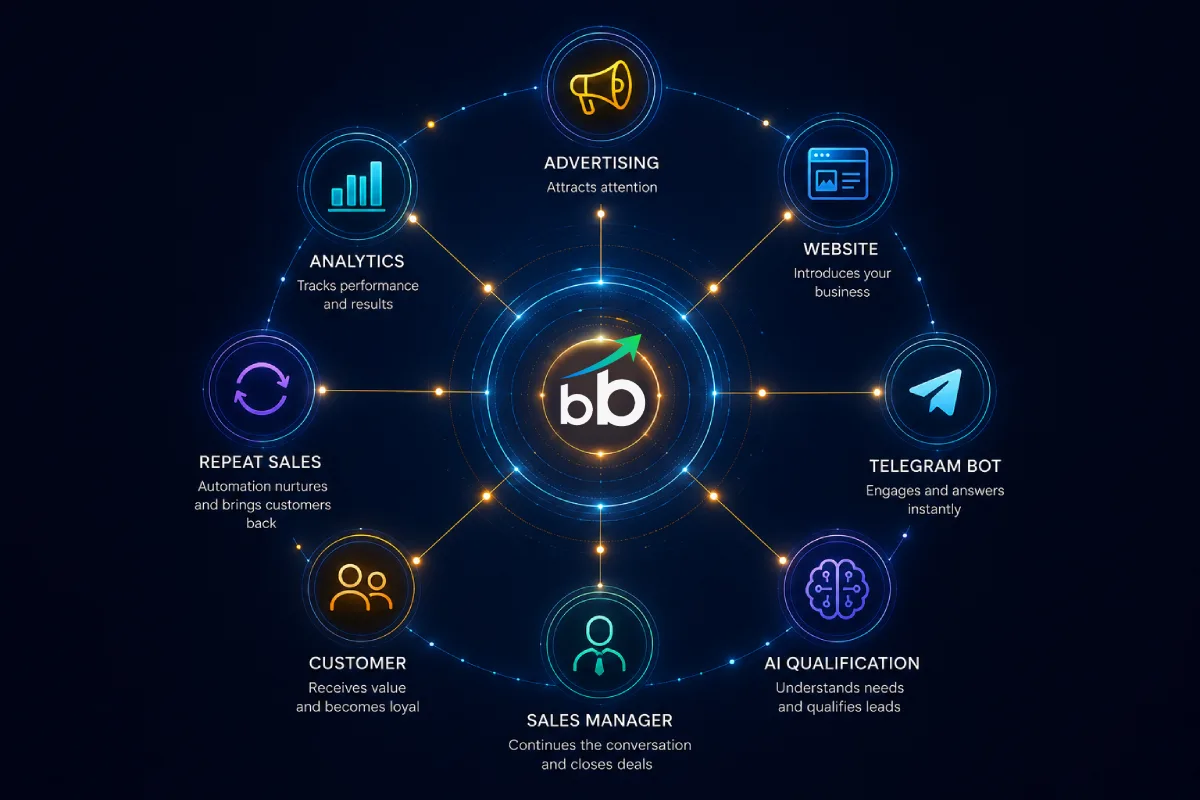
What a Modern Automated Sales Funnel Looks Like
A modern sales funnel is a connected system where every tool has a specific role.
For example:
- advertising attracts attention;
- the website introduces your business;
- a Telegram bot answers initial questions;
- AI qualifies the lead;
- customer information is stored in your sales system or CRM;
- a sales manager continues the conversation;
- analytics measures performance;
- automated workflows maintain communication after the sale.
Each stage supports the next, creating a consistent and manageable sales process.
Automation Helps Businesses Scale
As the number of inquiries grows, companies face a choice:
hire more people or improve the way work is organized.
Automation allows businesses to handle more leads without increasing the workload at the same pace.
The system takes care of repetitive tasks, while employees focus on consultations, negotiations, and closing deals.
Final Thoughts
Automation is not a single tool.
It is a way to organize the entire customer journey — from the first interaction to repeat purchases.
It helps businesses respond faster, simplify the work of sales teams, reduce lost opportunities, and gain complete visibility into the sales process.
The more consistent and connected this journey becomes, the more likely it is that interested visitors will become loyal customers.
Automation is never one-size-fits-all. Every business has its own processes, customer acquisition channels, and sales workflow. If you want to build an automated sales system tailored to your business, the BB.Center team can help you design and implement a solution that fits your goals.